Finnair to Launch Daily Helsinki–Melbourne Service via Bangkok
Finnair will fly daily from Helsinki to Melbourne via Bangkok from 25 October 2026, deploying the Airbus A350-900 on a one-stop, 15,000 km service that makes Melbourne the carrier's Australian gateway.
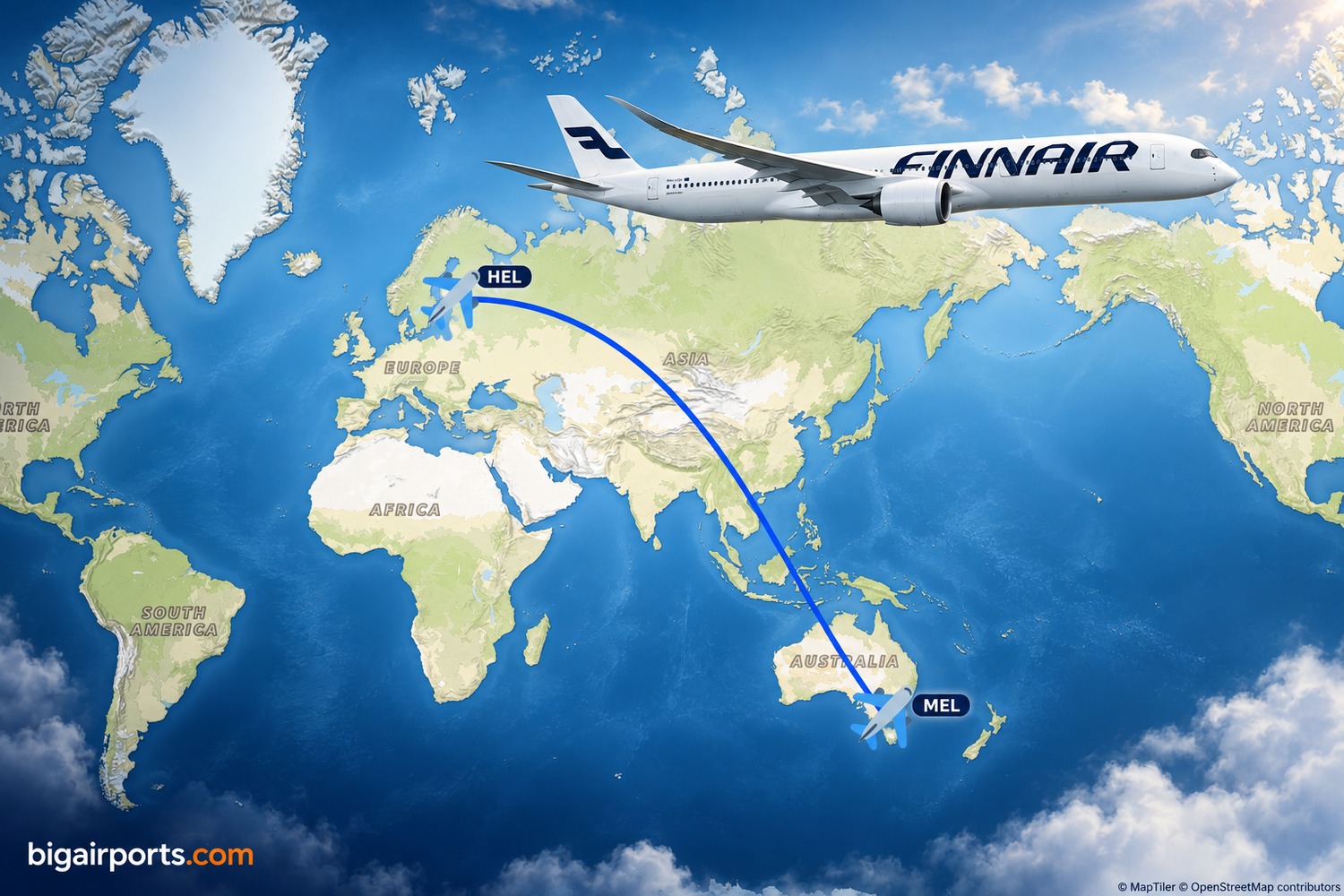
Finnair will begin a daily service between Helsinki Vantaa Airport and Melbourne Airport on 25 October 2026, operating via Bangkok Suvarnabhumi with Airbus A350-900 aircraft. The route makes Melbourne the Finnish flag carrier’s Australian gateway and creates a one-stop, single-flight-number link between the Nordic region and Australia’s second-largest city, with a scheduled journey time of around 24 hours.
- Airline
- Finnair
- Route
- Helsinki to Melbourne via Bangkok
- Aircraft
- Airbus A350-900
- Frequency
- Daily
- First flight
- 25 October 2026
Route overview
The service operates daily through Bangkok Suvarnabhumi, one of Finnair’s longest-standing Southeast Asian destinations and a long-established transfer point on the historic Kangaroo Route between Europe and Australia. The launch date of 25 October 2026 coincides with the start of the IATA northern winter 2026/27 scheduling season, the traditional point at which carriers reset their long-haul programmes.
End to end, the routing covers more than 15,000 kilometres: roughly 7,800 kilometres from Helsinki to Bangkok, followed by a further 7,350 kilometres on to Melbourne. Schedule data published by AeroRoutes shows the flight carrying a single Finnair flight number through Bangkok, positioning it as a direct one-stop product rather than a connection assembled from separate services. Reporting by Simple Flying puts the scheduled journey at close to 24 hours, which makes this one of the longest direct services Finnair has ever placed on sale. Aviation Week lists the route among roughly 50 new services launching worldwide in October 2026, and by sector length it stands out even in that crowded month of network changes.
Finnair’s network context
Finnair, a oneworld member headquartered at Helsinki Vantaa, built its long-haul business on the shortest great-circle routings between Europe and Northeast Asia. That geographic advantage was curtailed by the closure of Russian airspace in 2022, which added hours to the carrier’s Asian sectors and forced a broader rebalancing of its widebody flying. Finnair has since retained core Asian trunk routes such as Bangkok, Singapore and Tokyo while redistributing capacity across other regions, and the airline has kept Bangkok as one of the highest-volume leisure markets in its long-haul schedule.
Melbourne extends that rebalancing southwards. By routing through Bangkok, Finnair reaches Australia over a hub it already serves daily rather than opening an isolated new long-haul sector, keeping crew, maintenance and ground arrangements anchored to an existing station. Melbourne Airport’s own announcement describes the service as making the city Finnair’s Australian gateway, the carrier’s designated point of entry into the Australian market. For a network historically defined by its Europe–Asia transfer flows, a scheduled Australian destination marks a structural addition to the route map: the service is filed as a daily operation from launch, not a reduced-frequency trial, giving the carrier a consistent seven-day presence in the Australian market from the first week of operation.
About the aircraft
The Airbus A350-900 is the backbone of Finnair’s long-haul fleet. The airline was the first European operator of the type, taking its initial delivery in October 2015, and has since standardised its intercontinental flying on the A350. Powered by Rolls-Royce Trent XWB engines and built around a carbon-fibre-reinforced fuselage and wing, the A350-900 offers the range and fuel efficiency required for back-to-back long-haul sectors, and each leg of the Melbourne routing sits well within the type’s published capability of more than 15,000 kilometres.
Finnair’s current long-haul cabin, introduced from 2022, is built around the AirLounge business-class seat, a fixed-shell design without a conventional recline mechanism, alongside a premium economy cabin and economy class. That retrofit programme covers the A350 fleet operating the airline’s long-haul network, so the Melbourne routing slots into the same three-cabin product Finnair sells across its existing intercontinental services.
The airports: Helsinki Vantaa and Melbourne
Helsinki Vantaa, Finland’s principal international airport and Finnair’s home base, currently serves 148 routes, according to bigairports.com network data. Its densest links are European: Amsterdam is the single busiest connection with more than 3,300 tracked flights, ahead of Stockholm Arlanda on nearly 2,000, while Copenhagen attracts the broadest field with ten operators on the route. Seasonal Lapland flying to Rovaniemi and Ivalo adds a distinctive leisure layer. That dense short-haul feed underpins the transfer model on which the airport’s long-haul departures, Melbourne now included, depend.
Melbourne Airport, Australia’s second-busiest airport, serves 72 routes in the same dataset. Domestic trunk flying dominates: Sydney leads with 611 tracked flights across seven operators, followed by Brisbane on 379. Long-haul traffic is anchored in Asia, with Hong Kong at 396 tracked flights and Singapore served by five operators, alongside substantial leisure volume to Bali. The airport also operates around the clock with no curfew, a scheduling freedom that matters for ultra-long-haul arrivals and departures and that its Sydney counterpart cannot match.
Market context and competition
Europe–Melbourne traffic today flows almost entirely over intermediate hubs: Gulf carriers carry the market over Dubai and Doha, while Asian operators route passengers through Singapore and Hong Kong, both of which already rank among Melbourne’s busiest international links. Finnair’s proposition is structurally different from those hub products: a single-carrier, one-stop itinerary on a northern routing, with one booking, one airline and one stop between Helsinki and Victoria, sold under a single flight number for the full journey.
Within oneworld, the service places a European member alongside Qantas in its Melbourne hub, although no codeshare or onward-connection arrangements beyond the through service have been detailed in the launch material. The inaugural flight departs Helsinki on 25 October 2026, with daily rotations thereafter; its first northern winter will be the earliest meaningful read on how the one-stop model performs against the established hub carriers on this market.
Sources & references (4)
Generated with editorial oversight from AI research.