Alaska Airlines to Launch Seattle–Osaka Kansai Nonstop in May 2027
Four weekly Hawaiian-operated A330-200 rotations from 14 May 2027 give SEA and KIX their first nonstop link since 2019 and mark Alaska's eighth long-haul route from Seattle.
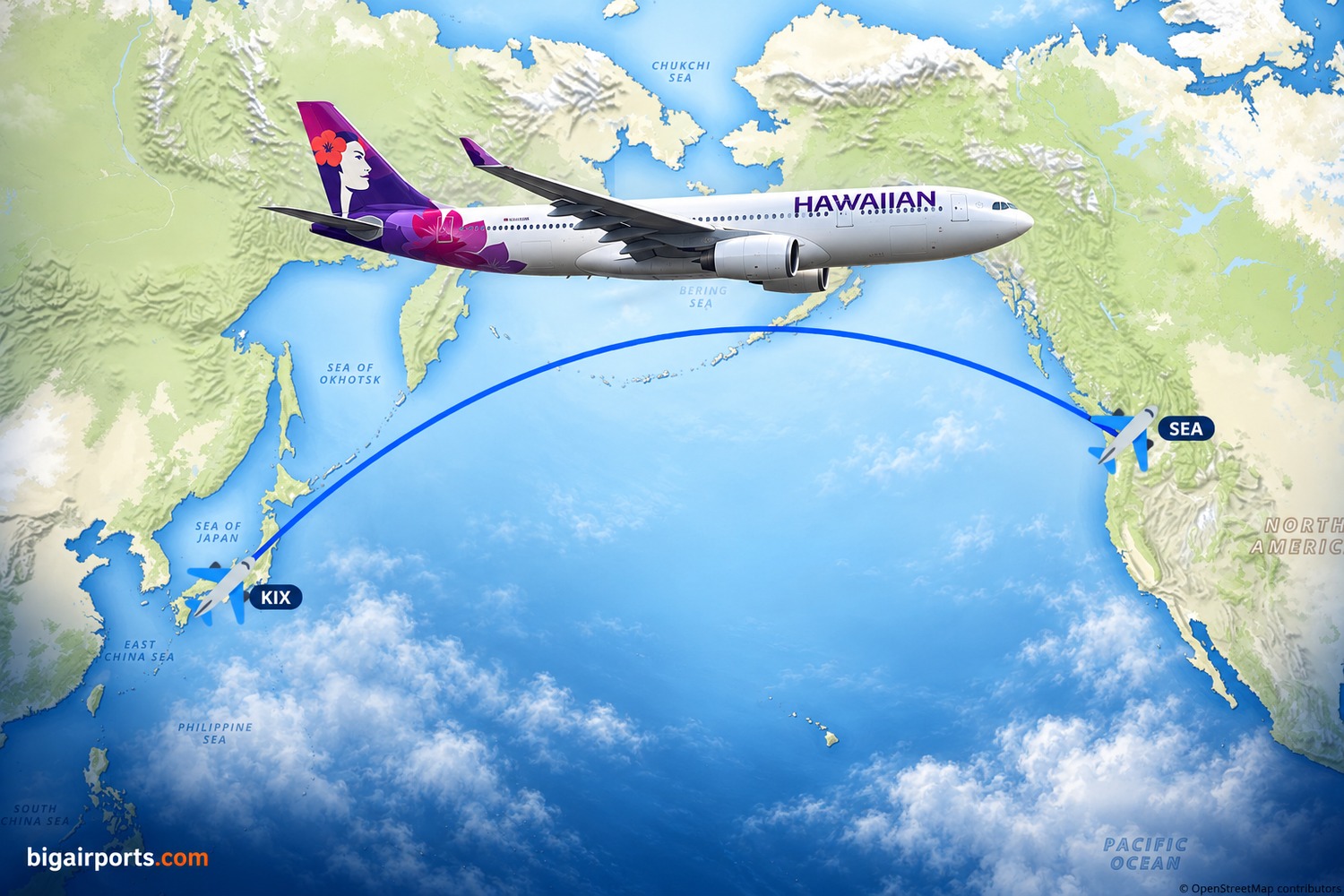
Alaska Airlines will open a four-times-weekly nonstop between Seattle–Tacoma and Osaka Kansai on 14 May 2027, the carrier confirmed on 20 October 2026. The route will be flown by a Hawaiian Airlines-branded Airbus A330-200 and is the only scheduled nonstop between the two airports. Kansai Airports notes it restores a direct link that has been absent since the summer 2019 schedule. The service is year-round and remains subject to government approval.
- Airline
- Alaska Airlines (Hawaiian Airlines-operated)
- Route
- Seattle–Tacoma (SEA) to Osaka Kansai (KIX)
- Aircraft
- Airbus A330-200, 278 seats
- Frequency
- Four weekly (Mon, Wed, Fri, Sun from SEA)
- First flight
- 14 May 2027
- Great-circle distance
- Approx. 8,090 km / 4,370 nm
Route overview
The westbound flight departs Seattle–Tacoma International Airport at 12:10 local on Mondays, Wednesdays, Fridays and Sundays and lands in Osaka at 16:00 the following day. The return leaves Kansai at 18:00 on Mondays, Tuesdays, Thursdays and Saturdays, arriving in Seattle at 12:20 the same calendar day. Based on the published timetable, scheduled block time works out at roughly 11 hours 50 minutes westbound and 10 hours 20 minutes eastbound. At 278 seats per rotation, the schedule adds 1,112 seats per week in each direction to the Seattle–Japan market.
The midday Seattle departure is built around Alaska’s domestic bank. The airline says the timing gives many points on its network the shortest one-stop path to Osaka, with inbound feed from West Coast and interior cities arriving during the morning. Alaska is marketing introductory round-trip Main Cabin fares from $1,199 until 26 October, and tickets are on sale through both the Alaska and Hawaiian channels.
Airline network context
Osaka is the eighth long-haul intercontinental route Alaska has announced from Seattle, with Papeete, confirmed on the same day for 11 June 2027, the ninth. The Seattle long-haul map for summer 2027 will comprise London, Tokyo Narita, Seoul, Rome, Reykjavík, Athens, Paris, Osaka and Papeete, with Athens starting on 12 May and Paris on 25 May. Under its Alaska Accelerate plan the group aims to serve at least 15 long-haul intercontinental destinations from Seattle by 2030.
The route also reshapes the Hawaiian side of the combined network. Hawaiian has flown Honolulu–Osaka daily since 2011 and will keep that service, so Alaska Air Group will serve Kansai from two hubs. Kansai Airports describes Seattle as Alaska’s second route at KIX and its third destination in Asia after Narita and Incheon. Seattle itself is the largest airline hub on the US West Coast, with 103 nonstop North American destinations on Alaska and Hawaiian.
The expansion comes against a difficult cost backdrop. Alaska Air Group posted a $76 million loss in the second quarter of 2026, with jet fuel prices up 85 per cent year on year. Management has nonetheless held to the international growth plan after signalling in recent weeks that a further Asia route was imminent.
About the aircraft
The A330-200 is Hawaiian’s standard long-haul type and the same aircraft Alaska deployed on Seattle–Narita and Seattle–Incheon. Kansai Airports lists the configuration at 278 seats: 18 in business and 260 in economy. The business cabin uses Hawaiian’s legacy lie-flat seats in a 2-2-2 layout. All Hawaiian-branded A330s offer Starlink Wi-Fi, which is free to Atmos Rewards members under a sponsorship with T-Mobile.
Alaska has committed to a nose-to-tail retrofit of the A330 fleet, with cabin work scheduled to begin in 2028. Until then, Seattle–Osaka will operate with the current interior. At roughly 8,090 km great-circle, the sector sits comfortably within the A330-200’s range.
About each airport
Seattle–Tacoma is one of the most internationally connected airports in the United States for its size. The Port of Seattle counts 61 international nonstop services to 36 destinations on 29 airlines, and five new international routes are already scheduled for 2027: Alaska to Athens, Paris, Osaka and Papeete, plus Delta Air Lines to Tokyo Narita in March. Six intercontinental services launched in 2026, including Cathay Pacific to Hong Kong and Delta to Rome and Barcelona. In bigairports.com schedule data the airport serves 162 routes, with the densest corridors being short and medium-haul domestic trunks to Anchorage, Portland, Denver and Phoenix. Amsterdam is the only route in the current sample tagged as long-haul, underlining how much of SEA’s intercontinental growth is still to come.
Kansai International Airport, built on a reclaimed island in Osaka Bay and open around the clock, is the principal international gateway for Japan’s Kansai region including Kyoto, Nara and Kobe. bigairports.com records 99 routes from KIX, overwhelmingly short-haul Northeast Asian trunks: Seoul Incheon is served by 13 operators, Shanghai Pudong and Taipei by ten each, and Hong Kong by eight. Long-haul services are comparatively thin, with Singapore and Bangkok the main tagged examples in the data. Kansai Airports says North American passenger traffic has been rising on strong inbound demand, and Seattle will make KIX’s third US mainland city after Los Angeles and San Francisco.
Market context and competition
There is no competing nonstop on Seattle–Osaka, and the pairing has been served only via connections since 2019. Current one-stop options route over Tokyo, Seoul, Taipei or Vancouver, so Alaska will be competing primarily on elapsed time and on its own domestic feed rather than against another carrier on the sector. Across the wider Seattle–Japan market, Alaska already flies Narita and Delta begins its own Seattle–Narita service in March 2027, which will add a second US carrier on Tokyo two months before the Osaka launch.
On the Kansai side, US mainland capacity remains limited to Japan Airlines on Los Angeles and United on San Francisco. Four weekly A330 rotations are a modest addition in absolute terms but meaningful for an airport whose long-haul network is still rebuilding. For Alaska, the test will be whether a secondary Japanese gateway can sustain year-round demand from Seattle without the leisure overlay that supports the Honolulu–Osaka route.
Sources & references (6)
Generated with editorial oversight from AI research.