Air India Adds Delhi-Osaka Kansai 787-8 Route From February 2027
Air India will fly four weekly Boeing 787-8 rotations between Delhi and Osaka Kansai from 2 February 2027, restoring a non-stop India to Kansai link and adding a second Japanese destination alongside Tokyo.
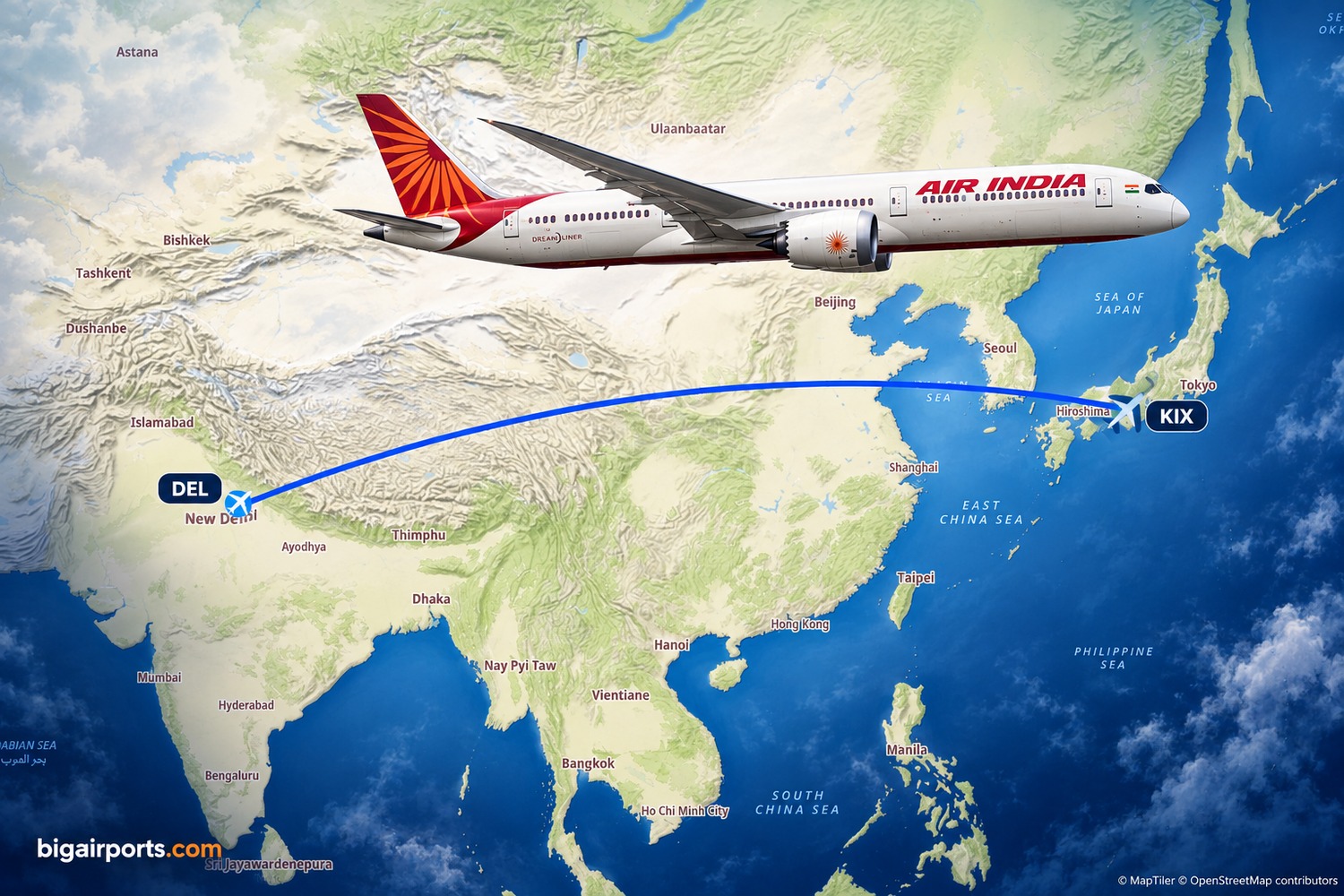
Air India will begin non-stop flights between New Delhi and Osaka on 2 February 2027, operating four weekly rotations with a Boeing 787-8. The service connects Indira Gandhi International Airport with Kansai International Airport and gives the Tata Group-owned carrier a second Japanese destination alongside its existing Tokyo service. Flights are scheduled on Tuesdays, Thursdays, Saturdays and Sundays and are now on sale through the airline’s direct and agency channels.
- Airline
- Air India
- Route
- Delhi (DEL) to Osaka Kansai (KIX)
- Aircraft
- Boeing 787-8
- Frequency
- Four weekly (Tue, Thu, Sat, Sun)
- First flight
- 2 February 2027
Route overview
The sector covers roughly 5,900 kilometres on a great-circle basis, placing it in the seven to eight hour block-time range in each direction depending on winds. Air India describes the launch as a return to Osaka, a city it served in earlier network configurations before withdrawing, and positions the route as a new gateway to western Japan for Indian travellers. The Kansai region, which takes in Osaka, Kyoto, Kobe and Nara, has until now been reachable from India only with a connection.
At four weekly frequencies the schedule is below daily, which is typical for an Indian carrier opening a new long-haul market. The chosen days cluster around the weekend and mid-week, a pattern that serves leisure demand while giving business travellers a Tuesday and Thursday option. Air India has not announced a step-up to daily, and no such plan should be assumed from the launch filing.
Air India network context
The Osaka launch sits within a broader international build-out under Air India’s Vihaan.AI transformation programme, which has seen the carrier add and restore long-haul points across North America, Europe and Asia since its 2022 privatisation. Japan has been served solely through Tokyo, where Air India has operated for decades. Adding Kansai doubles the airline’s Japanese footprint and feeds a codeshare relationship with All Nippon Airways, a fellow Star Alliance member, which can carry Air India passengers onward within Japan from Osaka.
The route is also consistent with the carrier’s emphasis on Delhi as its principal long-haul hub. The airline’s widebody flying from the capital reaches North America, the United Kingdom, continental Europe, Australia and East Asia, and the Osaka service adds another eastbound spoke to that structure. Air India has an order book of more than 500 aircraft placed since 2023, including additional Boeing 787s, which underpins the capacity for further network growth once deliveries accelerate.
About the aircraft
Air India will deploy the Boeing 787-8, the smallest member of the Dreamliner family and a type the airline has operated since 2012. The carrier’s legacy 787-8 cabin seats 256 passengers in two classes, with 18 flat-bed business class seats and 238 in economy. Air India is progressively refurbishing this fleet with new seats and in-flight entertainment, so the product on the Osaka route will depend on which airframes are rostered at launch.
On a four-weekly schedule, the configuration delivers 1,024 seats per week in each direction, or just over 100,000 annual seats on the city pair if frequencies hold through the year. The 787-8’s range of around 7,300 nautical miles comfortably exceeds the requirement, so payload restrictions are not expected on this sector. The type’s fuel burn also suits a thinner, non-daily market where a larger aircraft would be harder to fill.
About the airports
Indira Gandhi International Airport is India’s busiest airport and the main hub for both Air India and IndiGo. Current bigairports.com network data lists 178 routes from Delhi. The densest link by flight volume is Dubai, with 1,134 tracked flights across five operators, followed by domestic trunk routes to Mumbai, Bangalore and Kolkata. Amsterdam is the highest-volume long-haul destination in the dataset, with 470 flights shared between two carriers. The airport handles more than 70 million passengers a year and continues to expand its international widebody terminal capacity.
Kansai International Airport, built on a reclaimed island in Osaka Bay and opened in 1994, is the primary international gateway for western Japan. The same dataset records 99 routes from Kansai, heavily weighted towards North-east and South-east Asia. Seoul Incheon is the most contested link with 13 operators, while Hong Kong generates the largest flight count at 2,077. Shanghai and Taipei each draw ten operators. Long-haul services are comparatively thin, with Singapore and Bangkok the only destinations in the dataset classified as long-haul, which leaves room for new intercontinental entrants such as Air India.
Market context and competition
There is currently no non-stop service between India and Osaka by any carrier, so Air India will have the direct market to itself at launch. Indirect capacity between Delhi and Kansai is spread across one-stop itineraries via Bangkok, Singapore, Hong Kong and Tokyo, with Thai Airways, Singapore Airlines and Cathay Pacific among the main connecting options. Japanese carriers serve India only through Tokyo: All Nippon Airways operates Narita to Delhi and Mumbai, while Japan Airlines flies Haneda to Delhi and Bengaluru.
Demand drivers on the city pair include the Kansai region’s manufacturing base, home to Daikin, Panasonic and Sharp, all of which have significant Indian operations, together with a growing Indian tourism market to Japan and student and IT-sector traffic in both directions. Japan recorded record inbound visitor numbers in 2025, and Indian arrivals have been rising from a low base as visa processing has eased. Osaka’s hosting of Expo 2025 raised the city’s international profile ahead of the launch.
Competitive response is more likely from Gulf and South-east Asian hubs than from a second non-stop entrant. IndiGo has not yet announced Japan in its widebody plans, and no Japanese carrier has indicated an intention to serve India beyond Tokyo. Air India’s four weekly 787-8 flights therefore represent a measured opening position on a route the airline can scale if load factors justify it.
Sources & references (5)
Generated with editorial oversight from AI research.