TransNusa Adds Twice-Daily Denpasar–Surabaya COMAC C909 Service
TransNusa began two daily Denpasar–Surabaya rotations on 21 September 2026, putting its COMAC C909 up against narrowbody incumbents on one of Indonesia's densest domestic city pairs.
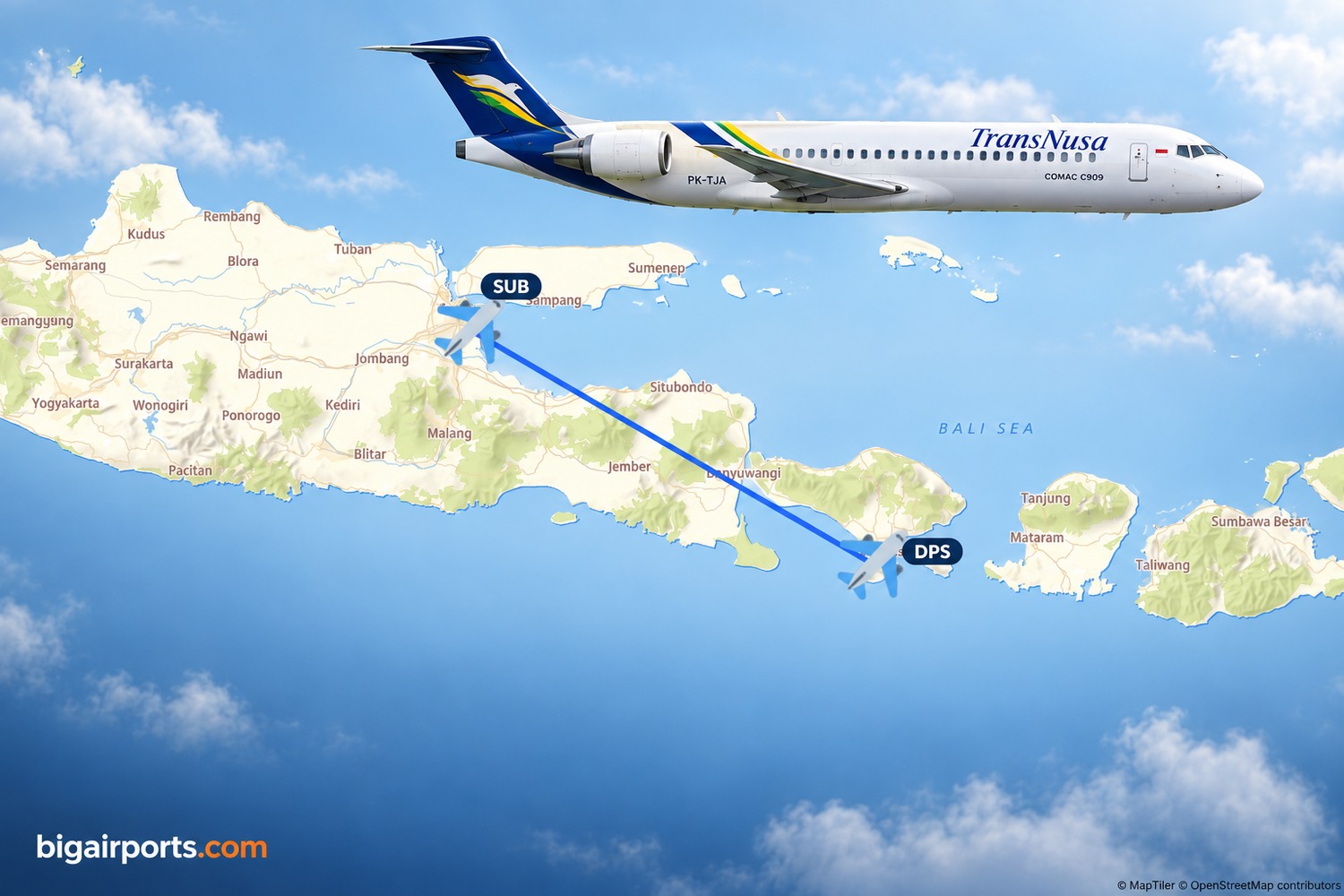
Route overview
TransNusa commenced scheduled services between Denpasar I Gusti Ngurah Rai International Airport and Juanda International Airport in Surabaya on 21 September 2026, operating two daily rotations with the COMAC C909. The launch places the Jakarta-based carrier on one of Indonesia’s densest domestic city pairs and continues the domestic expansion the airline has pursued through 2026.
- Airline
- TransNusa (8B/TNU)
- Route
- Denpasar (DPS) to Surabaya (SUB)
- Aircraft
- COMAC C909
- Frequency
- Twice daily
- First flight
- 21 September 2026
The service operates under flight number 8B5377, tracked on its opening rotation by Flightradar24, and covers a sector of roughly 300 kilometres across the Bali Strait with a block time of around one hour. Schedule data published by AeroRoutes confirms the twice-daily pattern effective from 21 September, giving TransNusa four movements a day across the pairing. The short stage length sits comfortably within the C909’s capabilities and puts the regional jet on a sector where turnaround discipline, rather than payload-range performance, drives utilisation.
The route links Indonesia’s principal leisure gateway with Surabaya, the country’s second-largest city and the commercial centre of East Java. Demand on the pairing is bidirectional and year-round: leisure traffic into Bali in one direction, and business and visiting-friends-and-relatives traffic into East Java in the other. Sub-hour sectors of this kind are the natural territory of a 90-seat regional jet, provided the operator can hold schedule against larger and more frequent incumbents.
TransNusa’s network position
TransNusa Aviation Mandiri relaunched in October 2022 as a hybrid carrier following the restructuring of its earlier regional turboprop operation, with backing linked to China Aircraft Leasing Group. Jakarta to Denpasar was its first post-relaunch route, and Bali has remained central to the network alongside international flying to Kuala Lumpur.
The carrier operates a mixed fleet of Airbus A320-family narrowbodies and COMAC C909s. It became the first operator of the Chinese type outside China when it accepted its initial aircraft in December 2022, placing it into commercial service in April 2023. The type has since been rotated across domestic and short international sectors as the airline has tested where the smaller gauge fits best, and the fleet decision remains the most closely watched aspect of the carrier: TransNusa is, in effect, the reference customer for the C909 outside its home market.
Indonesian regional outlet Lentera Kalimantan reported the Denpasar to Surabaya launch as part of a wider domestic network expansion, with TransNusa adding point-to-point sectors that do not route through its Jakarta base. By traffic density, this is among the strongest domestic markets the carrier has entered.
The COMAC C909
The C909 is the aircraft formerly marketed as the ARJ21-700, renamed by COMAC in November 2024 to align with the manufacturer’s C-series branding. China’s first indigenous regional jet programme, the type first flew in 2008, achieved domestic certification in 2014 and entered service with Chengdu Airlines in 2016. It is powered by two General Electric CF34-10A turbofans and typically seats around 90 passengers in single-class layouts, with a range of roughly 2,200 to 3,700 kilometres depending on variant.
More than 100 examples have been delivered, the overwhelming majority to mainland Chinese operators, which leaves TransNusa as the programme’s most prominent international customer. Each sector the Indonesian carrier adds extends the type’s operating record outside China, and Denpasar to Surabaya deploys it against substantially larger equipment on a market flown predominantly with 180-plus-seat A320-family and Boeing 737 aircraft.
The airports at each end
Denpasar I Gusti Ngurah Rai International, on Bali, is Indonesia’s primary tourism gateway and serves 75 nonstop destinations in current bigairports.com network data. Jakarta Soekarno-Hatta is its densest link at 626 flights in the current data window, followed by Singapore with 233. Surabaya ranks among the airport’s top domestic connections, with 190 flights flown by five scheduled operators, which is the market TransNusa has now entered.
The airport’s international footprint is broad for a leisure-driven market. Medium-haul links to Singapore, Kuala Lumpur and Perth sit alongside long-haul services to Melbourne, Sydney, Brisbane and Seoul Incheon, with Melbourne alone drawing six operators in the current dataset. Domestically, Jakarta, Surabaya, Lombok, Makassar and Labuan Bajo anchor a dense short-haul web.
Juanda International, serving the Surabaya metropolitan area, lists 55 nonstop routes with a profile that is overwhelmingly domestic. Jakarta Soekarno-Hatta leads at 533 flights, with Makassar at 490 and Balikpapan at 278 underlining Juanda’s role as a western gateway for traffic into Sulawesi and Kalimantan. Denpasar sits among its busiest handful of links.
International service from Juanda is concentrated on Kuala Lumpur and Singapore, with limited long-haul activity that includes pilgrimage-linked flying to Medina. The contrast between the two ends of the new route is stark: Denpasar’s traffic mix is international and leisure-led, while Juanda functions primarily as a domestic distribution point for eastern Indonesia.
Market context
bigairports.com data shows Denpasar to Surabaya flown by five scheduled operators, using predominantly A320-family and Boeing 737 narrowbodies. TransNusa’s C909 operation therefore enters at materially smaller gauge, offering roughly half the seats per departure of the incumbents’ typical equipment. That frames the service as a frequency and yield play rather than a capacity contest: two daily rotations of a 90-seat jet add measured capacity to a city pair already served at high frequency.
For the airports, the entry reinforces links that are already core to both networks. Surabaya is Denpasar’s third-busiest connection by flight count in current data, and Denpasar ranks fourth at Juanda. For COMAC, the route places the C909 in daily head-to-head competition with Airbus and Boeing products on a major domestic trunk sector, an operating environment in which the type has so far had limited exposure outside China. How the twice-daily pattern holds through the northern winter schedule will be visible in the frequency and operator counts for both airports as the season progresses.
Sources & references (3)
Generated with editorial oversight from AI research.