United to Launch Daily Chicago O'Hare-Tokyo Narita 787-8 Service
United Airlines will begin daily Boeing 787-8 flights between Chicago O'Hare and Tokyo Narita on 24 October 2026, adding a fourth daily Chicago-Tokyo frequency and feeding its new Narita-Sapporo service.
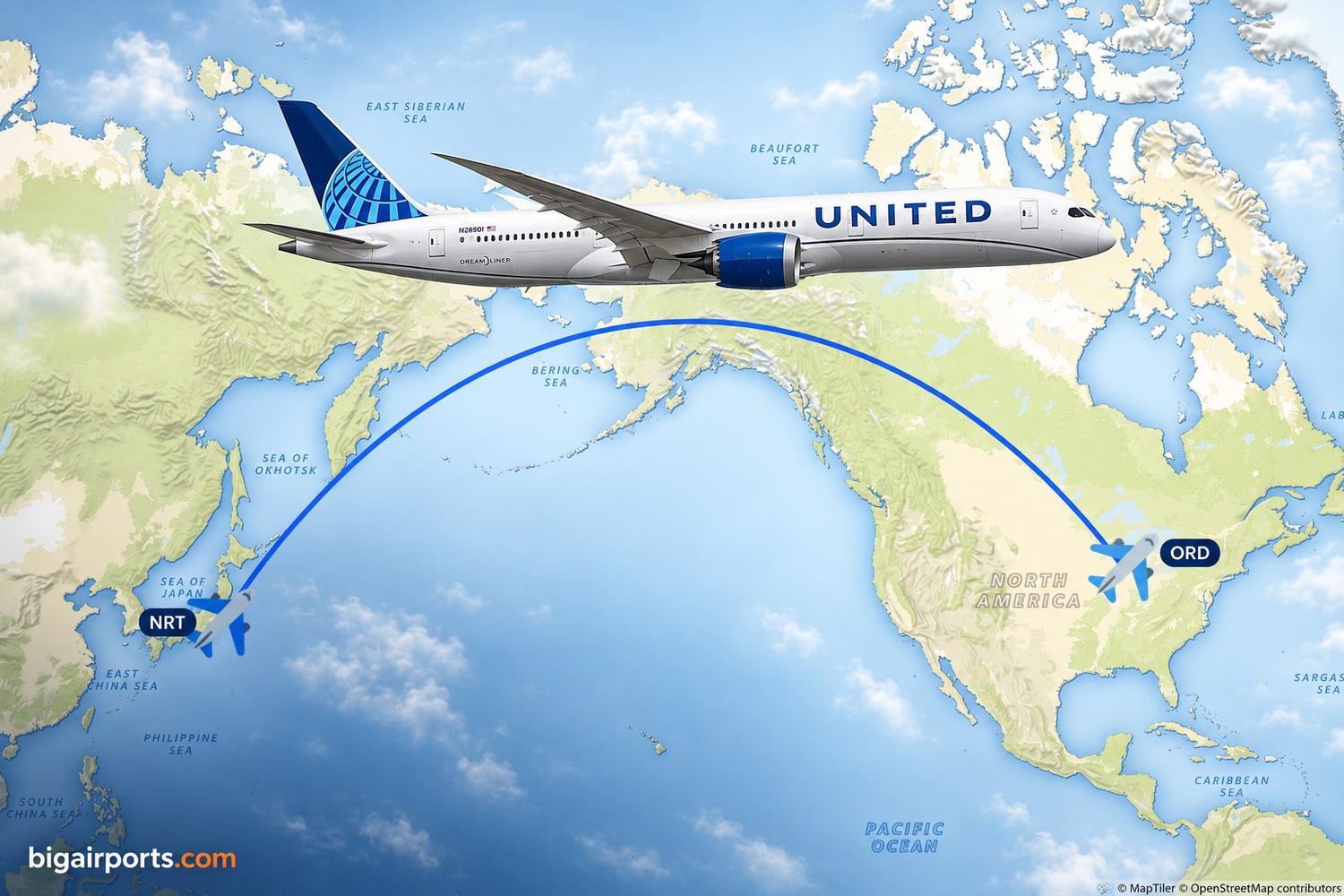
United Airlines will open a daily nonstop service between Chicago O’Hare International Airport and Tokyo’s Narita International Airport on 24 October 2026, operated by the Boeing 787-8. The launch restores a Chicago-Narita pairing on United’s own aircraft and arrives alongside the carrier’s newly announced onward service from Narita to Sapporo, its first route to Hokkaido.
- Airline
- United Airlines
- Route
- Chicago O'Hare (ORD) to Tokyo Narita (NRT)
- Aircraft
- Boeing 787-8
- Frequency
- Daily
- First flight
- 24 October 2026
Route overview
The new flight covers roughly 6,270 miles (10,090 kilometres) between the two airports, following the North Pacific great circle over Alaska. Westbound sectors against the prevailing jet stream are blocked at close to 14 hours, which places the route among the longest departures in United’s Chicago schedule; eastbound timings are materially shorter with tailwinds behind the aircraft.
Operating daily year-round, the 787-8 adds around 1,700 seats per week in each direction to the Chicago-Tokyo market. The schedule is built to connect at Narita with United’s new Narita-Sapporo (New Chitose) flight, announced at the same time, creating a single-carrier routing from the US Midwest to Hokkaido for the first time in the airline’s history.
The late-October start places the launch at the beginning of the northern winter scheduling season and ahead of Hokkaido’s peak winter demand period, when Sapporo’s ski resorts drive some of the strongest inbound leisure traffic in the Japanese domestic market.
United’s Pacific network context
United is the largest US carrier across the Pacific, and Tokyo anchors that position. For most of the past decade the airline has concentrated its mainline Tokyo flying at slot-controlled Haneda, which it serves nonstop from Chicago, Newark, Washington Dulles, San Francisco and Los Angeles.
Narita has been given a different job. Since 2024 United has been rebuilding the airport as a leisure-connection gateway, adding flights to Cebu, Kaohsiung and Ulaanbaatar alongside its long-standing Guam operation and existing US gateways. The Sapporo flight extends that strategy into the Japanese domestic leisure market, and the Chicago service gives the Narita operation direct widebody feed from the carrier’s largest hub in the central United States.
For O’Hare, the route deepens what is already United’s broadest international schedule. Chicago is the carrier’s home hub, and Narita becomes its second nonstop Japanese destination from the airport, after Haneda.
About the aircraft: the Boeing 787-8
United configures the 787-8 with 243 seats across four cabins: 28 Polaris business class seats, 21 Premium Plus premium economy seats, 36 Economy Plus extra-legroom seats and 158 seats in standard economy. It is the smallest member of the carrier’s Dreamliner family, which also includes the larger 787-9 and 787-10 variants.
The type’s combination of long range and moderate capacity has made it United’s standard tool for opening or rebuilding trans-Pacific markets where demand does not yet justify a 777-300ER or 787-10. On Chicago-Narita it lets the airline hold daily frequency, which underpins connections at both ends, while keeping the seat count conservative on a city pair that already carries three daily Tokyo services. The variant’s composite airframe and modern engines also give it markedly lower trip costs than the older widebodies it has progressively replaced across United’s Pacific network.
The airports: O’Hare and Narita by the numbers
Chicago O’Hare is one of the most connected airports in the world, with 330 active routes in bigairports.com network data. Its densest corridors are domestic: Atlanta draws 13 different operators, Dallas-Fort Worth 12, and New York LaGuardia a further seven. On the long-haul side its standout lanes are Shanghai Pudong, with 324 tracked flights across seven operators, and Anchorage, a largely cargo-driven corridor with 357 flights that reflects O’Hare’s role as a trans-Pacific freight gateway.
Narita counts 128 active routes and remains Japan’s principal long-haul connecting airport despite Haneda’s growth. Hong Kong is its busiest single link, with 1,699 tracked flights across 11 operators; Seoul Incheon is served by 20 different operators, the widest carrier field on any Narita route; and Taipei, Shanghai and Manila round out a dense regional web. Notably for this launch, the domestic trunk to Sapporo’s New Chitose already sees 388 flights across five operators, an indication of the underlying demand United’s connecting service will compete for.
Market context and competition
The Chicago-Tokyo market is today an all-Haneda affair. United, ANA and Japan Airlines each operate daily nonstops between O’Hare and Haneda, so the new service lifts the city pair to four daily flights and makes United the only carrier on the Narita side of it.
The competitive mechanics differ by airport. Haneda access is limited by a fixed pool of US carrier slot pairs, which constrains growth for every airline in the market; Narita is where additional Tokyo capacity can realistically be added. United also coordinates trans-Pacific schedules with ANA through their antitrust-immunised joint venture, while JAL’s O’Hare flight sits within the rival oneworld partnership with American Airlines, whose own Tokyo services operate from Dallas-Fort Worth and Los Angeles.
O’Hare’s own trans-Pacific record supports the case for additional Asian capacity. The airport’s Shanghai Pudong corridor is its single busiest long-haul passenger lane in the bigairports.com data, evidence that Chicago can sustain dense year-round service deep into Asia when the network behind each end is strong enough.
Against that backdrop, the Narita flight gives United something its Haneda services cannot easily replicate: connectivity to secondary Japan and leisure Asia. Passengers originating in Chicago gain one-stop access over Narita to Sapporo on United’s own aircraft, and to the wider Narita network beyond it. The first departure is scheduled for 24 October 2026.
Sources & references (4)
Generated with editorial oversight from AI research.