United Airlines Launches Daily Newark-Seoul Incheon 787-9 Service
United Airlines began daily nonstop Boeing 787-9 flights between Newark Liberty and Seoul Incheon on 4 September 2026, its second Seoul route and the only US-carrier nonstop in the New York-Seoul market.
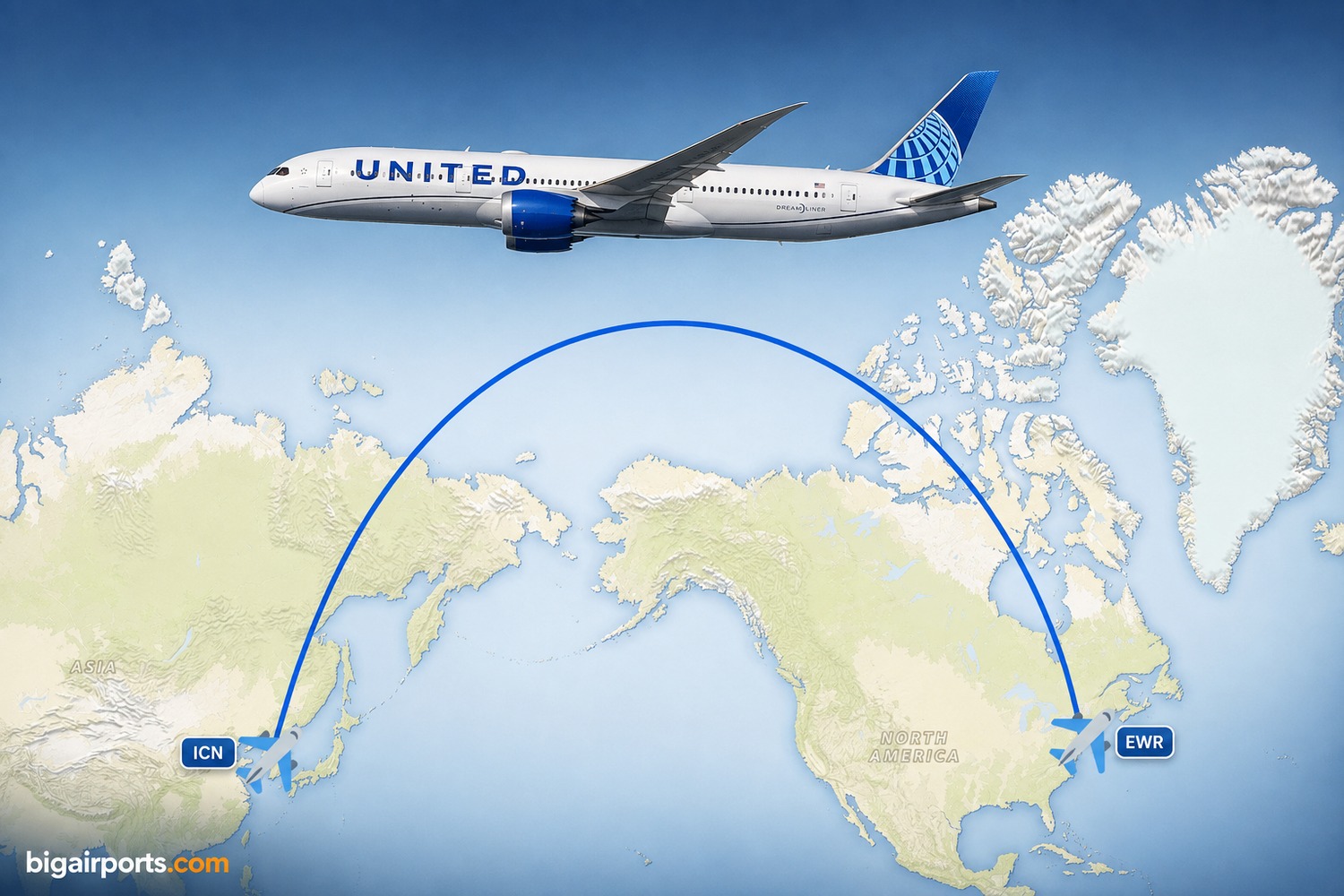
United Airlines operated its first scheduled flight between Newark Liberty International Airport and Incheon International Airport on 4 September 2026, opening a daily nonstop between its New York hub and South Korea’s principal international gateway. The service is flown with the Boeing 787-9 and gives United its second route to Seoul, complementing the carrier’s existing service from San Francisco.
- Airline
- United Airlines
- Route
- Newark (EWR) to Seoul Incheon (ICN)
- Aircraft
- Boeing 787-9
- Frequency
- Daily
- First flight
- 4 September 2026
Route overview
The new sector spans roughly 6,900 miles (11,100 km) on the great circle, placing it among the longest routes in United’s network. Westbound departures fly against the prevailing jet stream and carry a materially longer block time than the eastbound return; trade coverage ahead of the launch grouped the service with the small set of United sectors scheduled at around the 16-hour mark.
A daily rotation gives the market seven weekly frequencies in each direction, and, based on United’s standard long-haul 787-9 layout, close to 1,800 seats per week each way. At launch the flight stands as the only US-carrier nonstop between the New York area and Seoul, with the remaining nonstop capacity on the city pair in Korean hands.
A second Seoul route in United’s network
United has served Seoul from San Francisco since 2021, and the Newark launch extends that presence to the East Coast for the first time. The addition sits within a broader long-haul expansion at the carrier, which has also announced four new European routes for 2026 from its coastal hubs, and it deepens Newark’s role as United’s principal international gateway on the Atlantic side of its network. Seoul also broadens the hub’s Asian offering beyond its established Tokyo service, giving the New Jersey airport a second one-stop path into Northeast Asia’s connecting networks.
For connectivity, the schedule is designed to feed from United’s domestic banks at Newark, drawing traffic from the eastern United States onto the Seoul departure. Incheon becomes a second Northeast Asian spoke from the New Jersey hub, and the carrier will rely primarily on its own network for feed at both ends rather than on partner capacity, a point that matters given the changing alliance picture in Seoul covered below.
About the aircraft
The Boeing 787-9 is the mid-size member of the Dreamliner family and the backbone of United’s long-haul fleet. United configures the type with 257 seats across four cabins: 48 Polaris business-class suites with direct aisle access, 21 Premium Plus recliners, 39 extra-legroom Economy Plus seats and 149 standard economy seats.
With a range of approximately 7,500 nautical miles, the variant covers the Newark to Incheon sector with reserves in hand, and its per-seat fuel economics are what make ultra-long, thinner markets of this kind commercially workable at daily frequency. The premium-heavy layout also suits a corporate-driven market such as New York to Seoul, where business demand underpins the front cabins.
Newark and Incheon: the two airports
Newark Liberty currently shows 234 routes in bigairports.com network data. The busiest links are domestic trunk markets: Atlanta leads with 299 flights in the current schedule period, followed by Orlando on 261 and Fort Lauderdale on 208. On the long-haul side, Madrid tops the table with 668 flights across two operators, while Los Angeles is served by five carriers on 158 flights. Washington Dulles, Chicago O’Hare and Dallas-Fort Worth each show six operators, underlining how contested the airport’s core domestic markets remain. The airport’s mix skews heavily towards United’s hub operation, which supplies the connecting feed the new Seoul flight depends on.
Incheon is the larger international network, with 201 routes concentrated on intra-Asian flying. Its densest link by a wide margin is Hong Kong, with 1,367 flights across 18 operators, followed by short-haul Japanese markets: Osaka Kansai on 360 flights, Tokyo Narita on 308 and Fukuoka on 229. Vietnamese leisure destinations, including Da Nang, Nha Trang and Hanoi, feature prominently, and Anchorage appears high in the table with 254 flights, a link sustained largely by freighter traffic. On the passenger long haul, Los Angeles shows 147 flights across four operators; United’s launch now adds a New York-area link to that transpacific portfolio.
Market context and competition
The New York to Seoul market has until now been served principally over JFK, where Korean Air operates nonstop and Asiana Airlines, in the process of being absorbed into Korean Air following their merger, has also flown the route. From Newark itself, Air Premia, the Seoul-based hybrid carrier, operates Incheon flights with its own 787-9s, meaning United faces direct competition on the airport pair from day one.
United’s response rests on structural advantages rather than price: hub feed at Newark, a large loyalty base and corporate contracts across the New York metropolitan area. The consolidation of the two big Korean carriers also changes the alliance arithmetic. With Asiana expected to leave Star Alliance as the merger completes, United would otherwise have been left without a nonstop option to Seoul for its New York-originating passengers, so flying the route with its own metal removes that dependency at a sensitive moment and keeps the carrier’s Seoul access under its own commercial control.
How the capacity settles will depend on demand across both business and visiting-friends-and-relatives traffic, but the carrier has committed to daily, year-round scale from the outset rather than a seasonal trial, a signal of intent in a market where its competitors are well entrenched.
Sources & references (4)
Generated with editorial oversight from AI research.